Why Chameleons Change Color — Mood, Temperature, and Messages
Watch two males face off on a branch and the “why” of chameleon color change stops looking like a stealth tutorial. Colors flare. Contrasts sharpen. The performance is aimed at another chameleon’s eyes. That scene is a useful entry point: before asking about hiding in leaves, ask what message the skin is sending, how temperature shapes reflectance, and how internal state writes itself across the body.
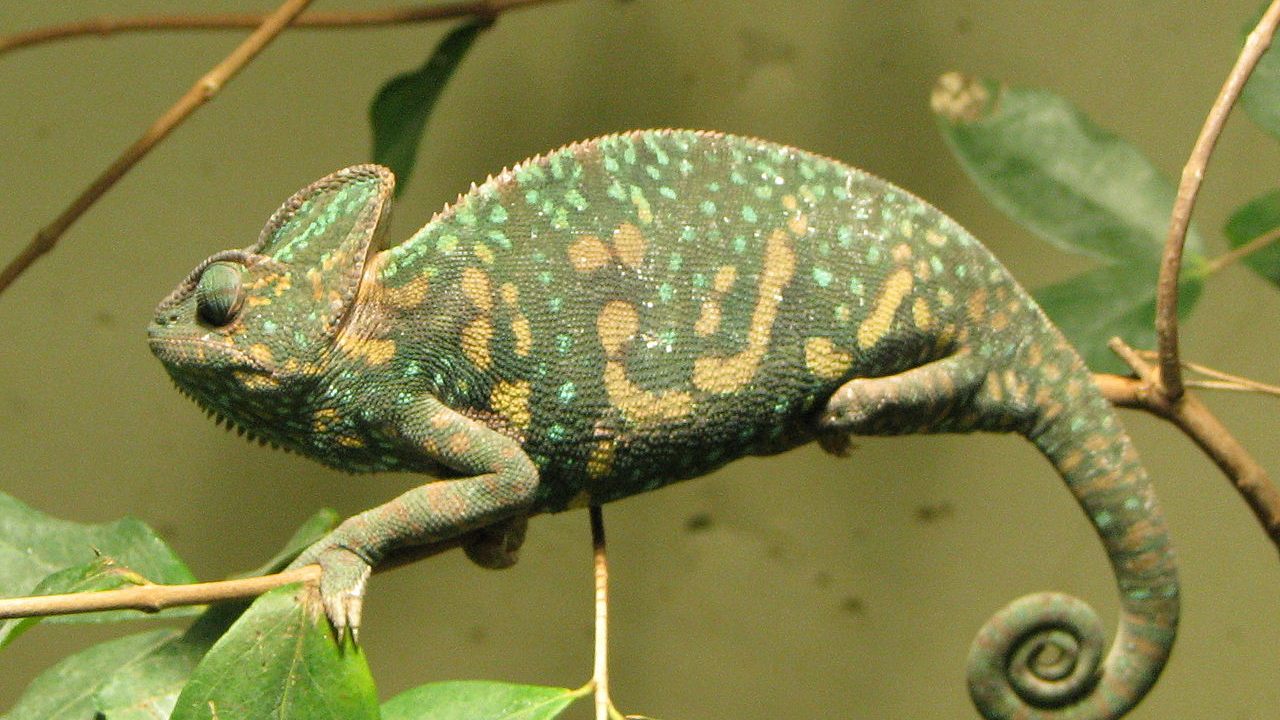
Educational illustration of a social display encounter
A brighter shift is often a message
In species known for dramatic displays, a sudden move toward yellow, orange, or red is frequently a signal. Structural color—tunable spacing of guanine nanocrystals in superficial iridophores—makes those shifts optically possible, as shown in detail for panther chameleons (Teyssier et al., Nature Communications, 2015). Functionally, the brightening answers a social problem: who is motivated, who is ready to escalate, who is advertising.
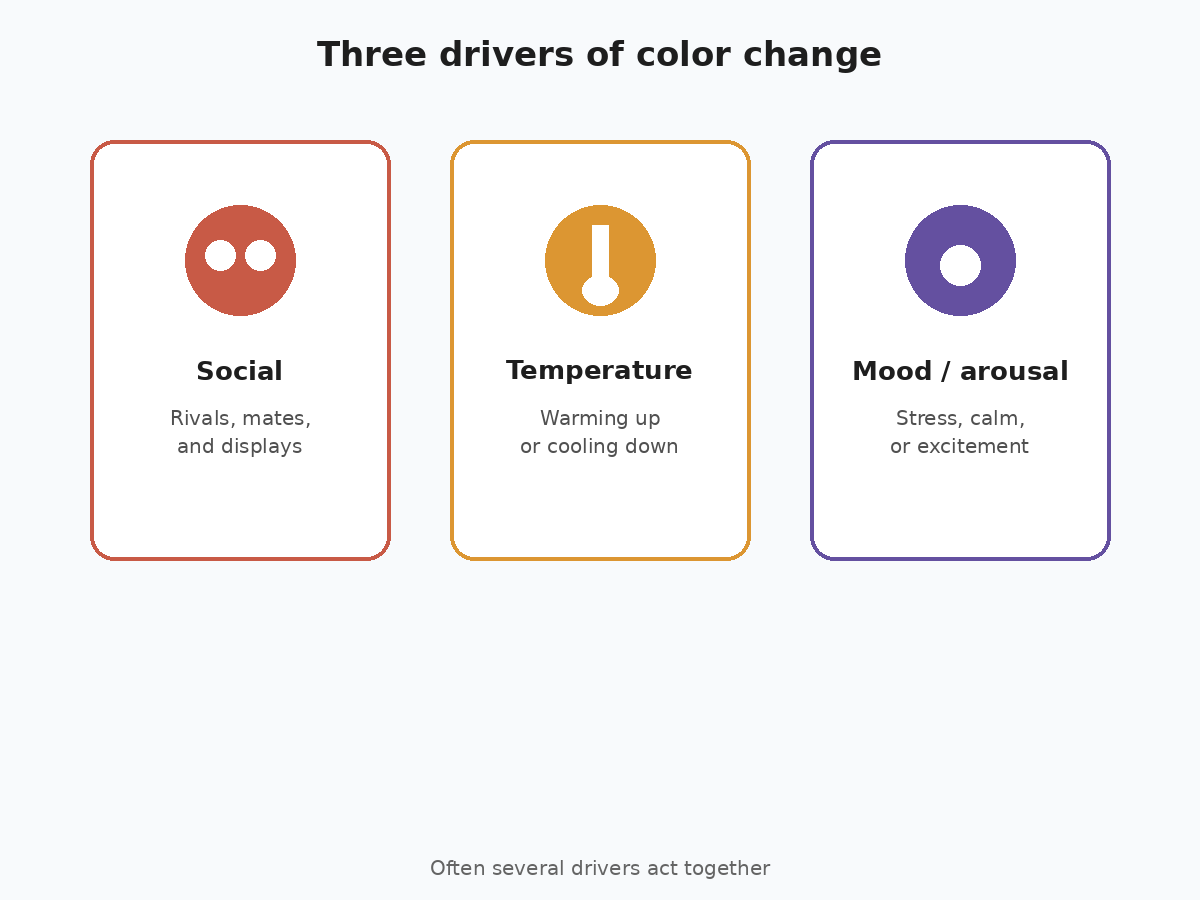
Three common drivers behind visible color shifts
Leading with messages does not deny other functions; it corrects a popularity bias. Search culture and cartoons taught generations that hiding is the whole plot. Behavioral sequences at close range tell a different story: color is often aimed at conspecifics first.
Showing off in a conflict
Conflict color is not decoration for its own sake. Escalating hues can correlate with willingness to fight or with condition that rivals assess. Darker or less saturated opponents may withdraw earlier. Color thus participates in assessment—an information exchange that can substitute for some physical combat. Why change? To be readable in a dispute.
Readability cuts both ways. A signal that is too costly or too dishonest collapses; a signal that is invisible fails. Dynamic structural color lets males update the broadcast as the encounter unfolds—seconds to minutes—rather than waiting for slow pigment turnover. That timing fit is part of the functional argument for photonic change in social contexts.
Attracting a mate
Courtship reframes the same hardware for a different receiver. Males may present intensified patterns when approaching females. Females may answer with species-typical colors tied to reproductive condition. Again, concealment is a poor fit for the behavior: mating signals need detection. The “why” is reproductive communication layered on top of whatever crypsis the animal uses at other times of day.
Species differ in how showy courtship becomes. Some lineages lean on motion and posture as much as hue; others couple both. The shared educational point is that mating dialogue uses appearance—and appearance can be rewritten quickly when lattices and pigments cooperate.
Color as a thermostat helper
Messages are not the only job. Ectotherms live by the physics of heat. Skin that absorbs more visible and near-infrared energy warms differently than skin that reflects more of that energy. Researchers link some color and reflectance changes to thermoregulation: darkening to soak up morning sun, lightening or altered reflectance to avoid overheating.
Panther chameleon work highlighted a deeper iridophore layer that reflects near-infrared strongly—less about the rainbow of a duel, more about managing heat. That thermal “why” can operate in parallel with social color. An animal might move into sun and interact with a neighbor; skin does not get only one assignment per hour.
Thinking of color only as a social costume therefore misses half the physics. Reflectance is energy management. Darkening and lightening change the budget of absorbed sunlight; near-infrared reflectance changes the budget further. “Why change color?” includes “to help stay in a workable temperature band,” even when the shift looks modest to a casual viewer.
Emotional state, not a fashion choice
People love the mood-ring metaphor. It captures something real—color tracks state—and something false—the idea of deliberate styling. Arousal, stress, and calm feed physiological pathways that reset skin optics. Calling that “emotion” is fine as shorthand if we remember lizards are not shopping for looks.
What remains unsettled scientifically is the finest grain of control: how cellular machinery precisely dials nanocrystal spacing in response to neural and hormonal input. Authors of the 2015 study were explicit that those mechanisms were still to be worked out. The functional claim can still stand: state changes appearance; appearance informs others and interacts with the physical environment.
Until that cellular map is complete, teachers and writers should prefer cautious verbs—“linked to,” “associated with,” “researchers describe”—over fake precision about named molecules doing named steps. Functional ecology can be taught honestly without inventing a mechanism diagram.
The camouflage myth, carefully unpacked
Why do so many explanations start with camouflage? Because resting chameleons often look plant-like, and because matching backgrounds is a memorable story. The myth is not that crypsis never occurs; it is that camouflage is the main reason for all color change, especially the rapid fireworks.
Unpacking the myth means separating modes:
Flashy social change — usually communication; camouflage is a weak primary explanation.
Thermal reflectance shifts — about energy balance.
Quieter matching to foliage or bark — can support crypsis; strength of that role varies by species and setting.
Absolute denial of camouflage overcorrects. Absolute loyalty to camouflage underexplains contests and courtship. Science-friendly wording stays graded: camouflage contributes variably; social and physiological drivers dominate the famous rapid shifts in well-studied display species.
A helpful classroom move is to imagine two scenes side by side: a high-contrast displaying male and a low-contrast resting animal in vegetation. Ask which “why” fits each image better. The difference is usually obvious; the myth survives mainly when only the stealth story is told.
What “why” means for different species
Panther chameleons taught the modern structural story and showcase intense social coloration. Other chameleons may emphasize different balances—more darkening and lightening, narrower palettes, less explosive rivalry displays. Habitat, predators, and mating systems differ across the family. Therefore “why chameleons change color” is really a plural question: why this species, in this context, shifts this way.
Borrow mechanisms cautiously across species. Borrow functions even more cautiously. A thermal or crypsis-weighted lifestyle in one lineage does not erase signaling in another.
Even within one species, sex and season matter. Males and females do not always share the same display repertoire; reproductive cycles reshape what colors appear and when. A complete “why” answer is ecological and demographic, not a single sentence for all individuals.
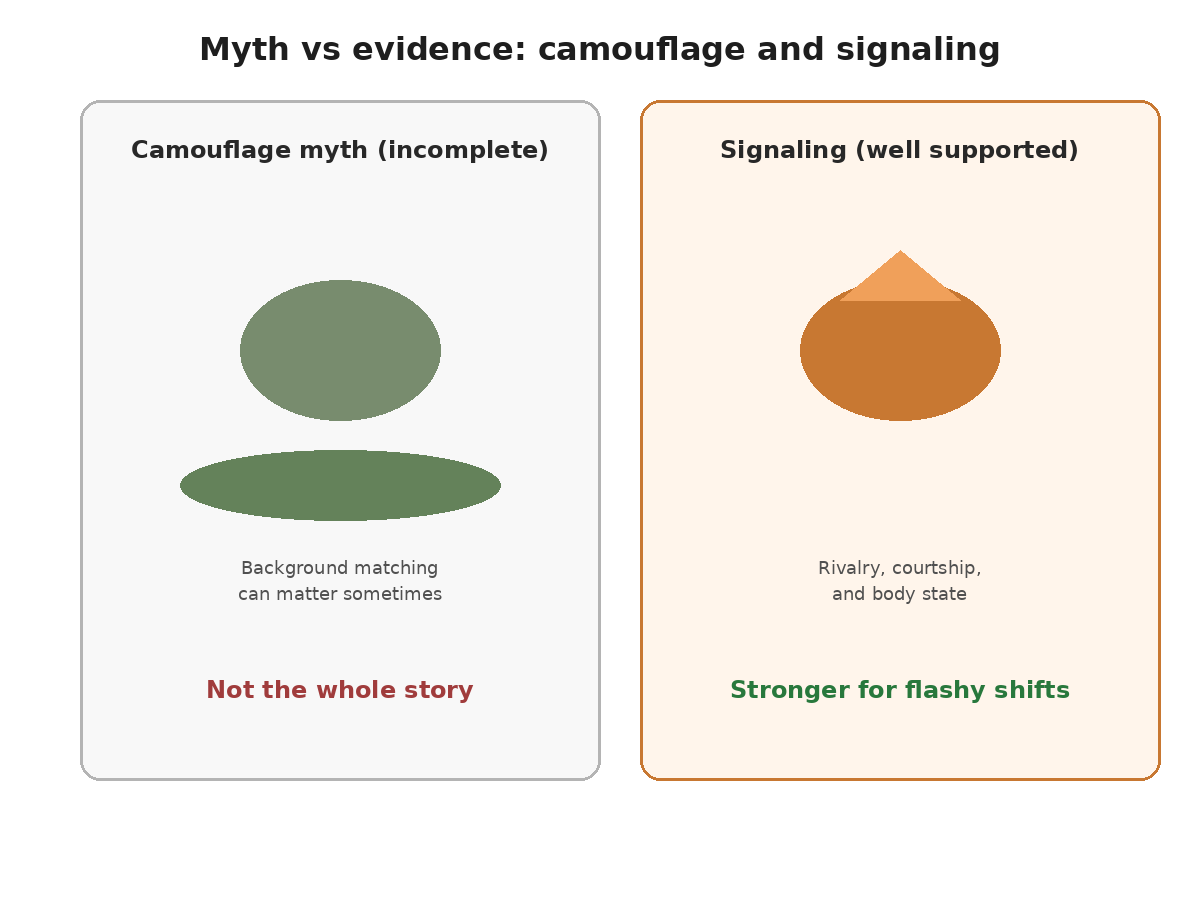
Contrast between a camouflage-only myth and signaling evidence
Takeaways for curious readers
Lead with messages when colors suddenly intensify during encounters.
Keep temperature in the model whenever reflectance and basking behavior matter.
Read mood/arousal as physiology, not wardrobe selection.
Treat camouflage as real-but-overstated for flashy change; contribution varies.
Remember species limits: one research favorite is not the whole clade.
Hold open questions on exact cellular control without inventing pathways.
Three main whys — plus one nuance
Communication — rivalry, courtship, and status cues that need to be seen.
Temperature — reflectance that helps the animal warm or stay cooler, including near-infrared roles discussed for deeper iridophores.
Physiological state — arousal, stress, and calm written into skin optics.
Nuance: Background matching can matter, but it is not the universal main reason for rapid, high-contrast shifts. How much crypsis weighs in depends on species and moment.
That four-part answer—three whys and one careful nuance—is a sturdier reply than the single word “hide,” and it stays honest about what researchers emphasize and what they still do not fully know.
Carry those four points forward when you read popular headlines. If a headline says chameleons change color “to disappear,” check whether the story shows a disappearing act or a billboard. The skin can do both kinds of work across a life—but the brightest shifts are usually messages, thermostat helpers, and state readouts long before they are invisibility cloaks.