How Chameleons Change Color: Skin, Light, and Signals
Ask almost anyone how chameleons change color and you will hear a tidy story: they match their surroundings the way a spy matches wallpaper. Cartoons lean hard on that idea. Real skin is more interesting—and more optical. In species famous for vivid displays, much of what we see comes from light reflecting off ordered nanocrystals, layered with pigments that add yellow, red, and shade. The animal’s body state decides when those optics rearrange. Understanding that mix of physics and physiology is the clearest way to answer how chameleons change color without recycling the cartoon script.
Triggers that shift the lattice
Architecture enables change; triggers decide timing. Scientists still do not have a complete molecular map of how cells widen or tighten crystal spacing—that control pathway is an acknowledged open question—but behavioral patterns are well described in many species.
Rivalry and courtship displays
Male–male contests are classic stages for rapid brightening. Two animals size each other up; postural threats combine with color intensification. Brighter, more contrasting patterns can signal condition, motivation, or dominance. Courtship adds another channel: males may present bold hues toward females, while females can show patterns linked to receptivity or rejection depending on species.
These scenes make poor camouflage stories. They make excellent communication stories. The skin becomes a billboard whose pixels are nanocrystals and pigments under physiological control.
Field observers have long noted that display colors intensify with posture and movement: lateral compression, head movements, and gaping often travel with brighter skin. The “why” of the flash is social information; the “how” is optics. Keeping those questions separate prevents the old camouflage slogan from swallowing the evidence.
Staying cooler or warmer with the help of skin
Temperature is the quieter co-star. Because chameleons depend on external heat, skin reflectance influences energy gain. Darker appearances can favor warming; higher reflectance in relevant bands can reduce overheating. A deeper iridophore population described in panther chameleons reflects strongly in the near-infrared, a region tied more to heat management than to the rainbow we notice first. Researchers discuss that deeper layer as a candidate for passive thermal roles.
Social flashes and thermal adjustments can overlap in time, which is one reason a single “why” rarely covers every color event. The same organ system serves messaging and climate control.
In practice, that means a morning basker darkening on a branch and an afternoon rival brightening toward a competitor may both “change color,” yet they are solving different problems. Educators who collapse both into camouflage erase the thermal and social chapters that research actually highlights.
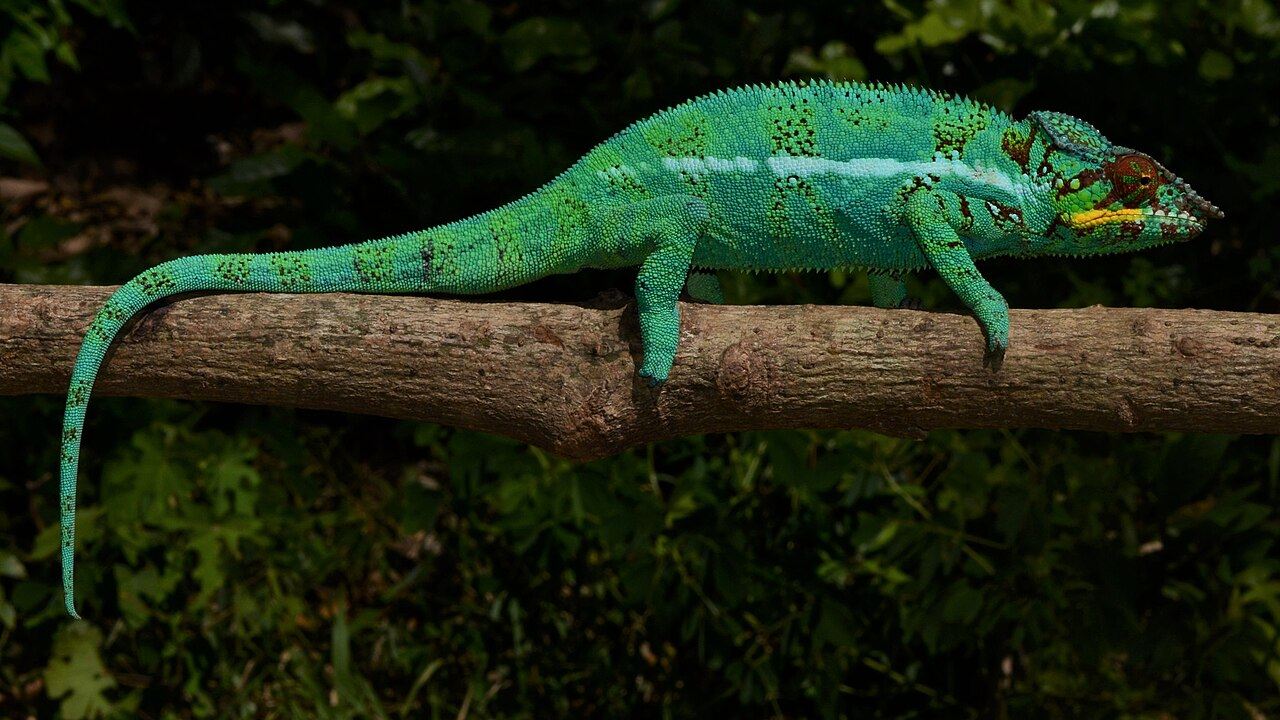
Educational illustration of a lizard on a branch
Why the cartoon version is incomplete
The cartoon version usually claims three things at once: color change equals camouflage; pigment slides around like wet paint; and the lizard picks a look the way a person picks a shirt. Each claim needs repair.
Camouflage is not ruled out, but it is a weak explanation for sudden, high-contrast yellows and reds that shout rather than hide. Pigment cells do matter, yet they are only part of the stack. And “picking” a color overstates intention: nerves and hormones drive skin changes linked to rivalry, courtship, arousal, and temperature. Landmark measurements on panther chameleons showed that active tuning of crystal spacing can rewrite reflected color on short timescales (Teyssier et al., Nature Communications, 2015). That finding moved the conversation from paint-only stories to photonic ones—without erasing pigments from the cast.
Another reason the cartoon fails is timescale. Cartoons imply an instant wallpaper match whenever the scenery changes. Real animals mix fast social flashes with slower thermal adjustments and quieter resting tones. Bundling every shift into one “camouflage reflex” hides that variety. A better starting question is: which kind of change am I watching—display, temperature, or subtle matching—and which skin layers are doing the work?
Color from light, not paint
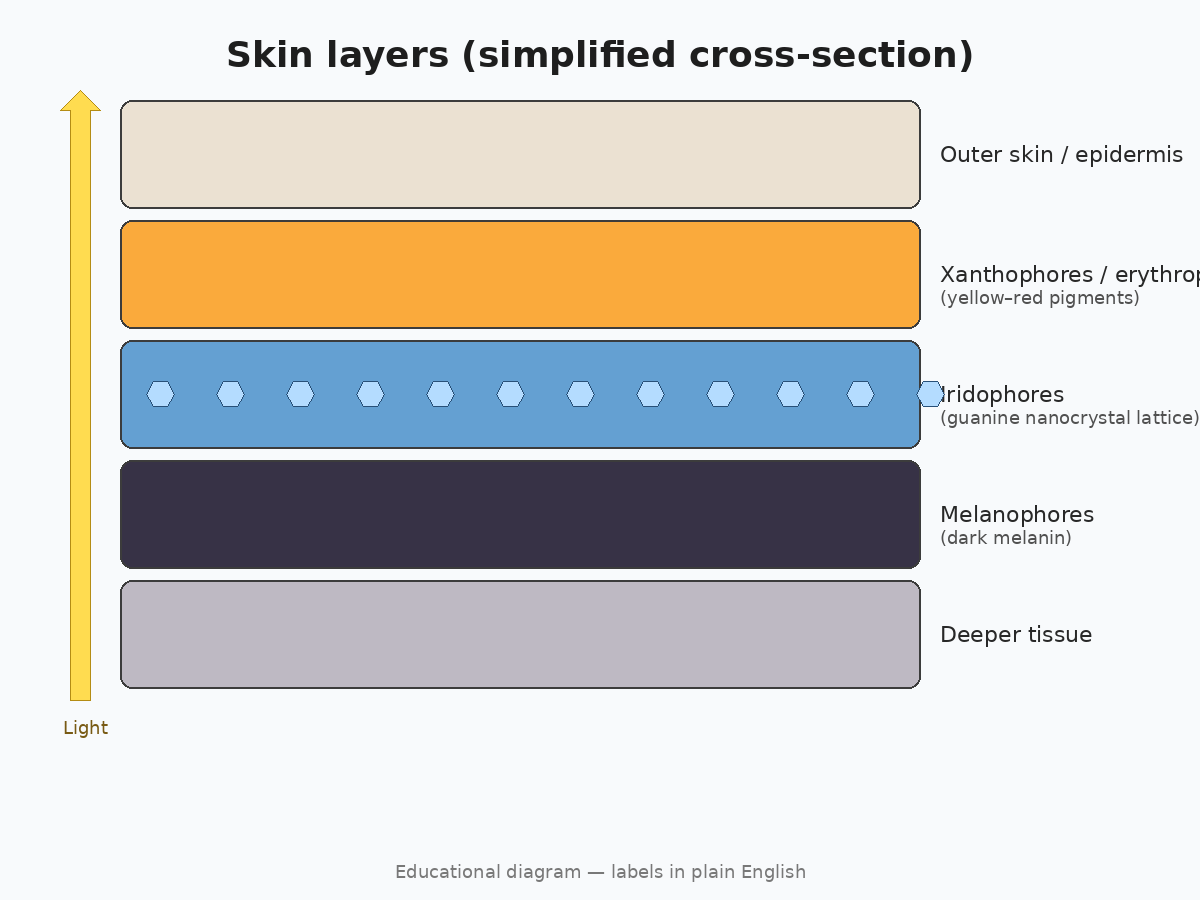
Simplified cross-section of the skin layers involved in color
When light hits chameleon skin, some wavelengths bounce back toward your eyes and some are absorbed. Structural color arises when microscopic architecture—not dye alone—selects which wavelengths return. Chameleons combine that architecture with true pigments.
Camouflage vs communication (what science actually emphasizes)
Science communication around chameleons has spent years correcting an oversold camouflage myth. The correction is careful: background matching is possible and can matter for crypsis in foliage or on bark, yet the rapid, saturated shifts that made chameleons cultural icons align more strongly with signaling and physiological state in species where those shifts are best measured.
How large a share camouflage claims in daily life depends on species, habitat, predators, and moment. Avoid absolutes. Prefer ranked emphasis: for flashy change, communication and body state lead; camouflage is a secondary or situational contributor, not the universal main reason.
One practical check helps: ask whether the new colors make the animal harder or easier to notice from a typical viewing distance. Courtship reds and rivalry yellows usually fail the “harder to notice” test. Soft greens against foliage may pass it. Both can be true in one life; they are not the same phenomenon wearing one label.
Guanine nanocrystals in iridophores
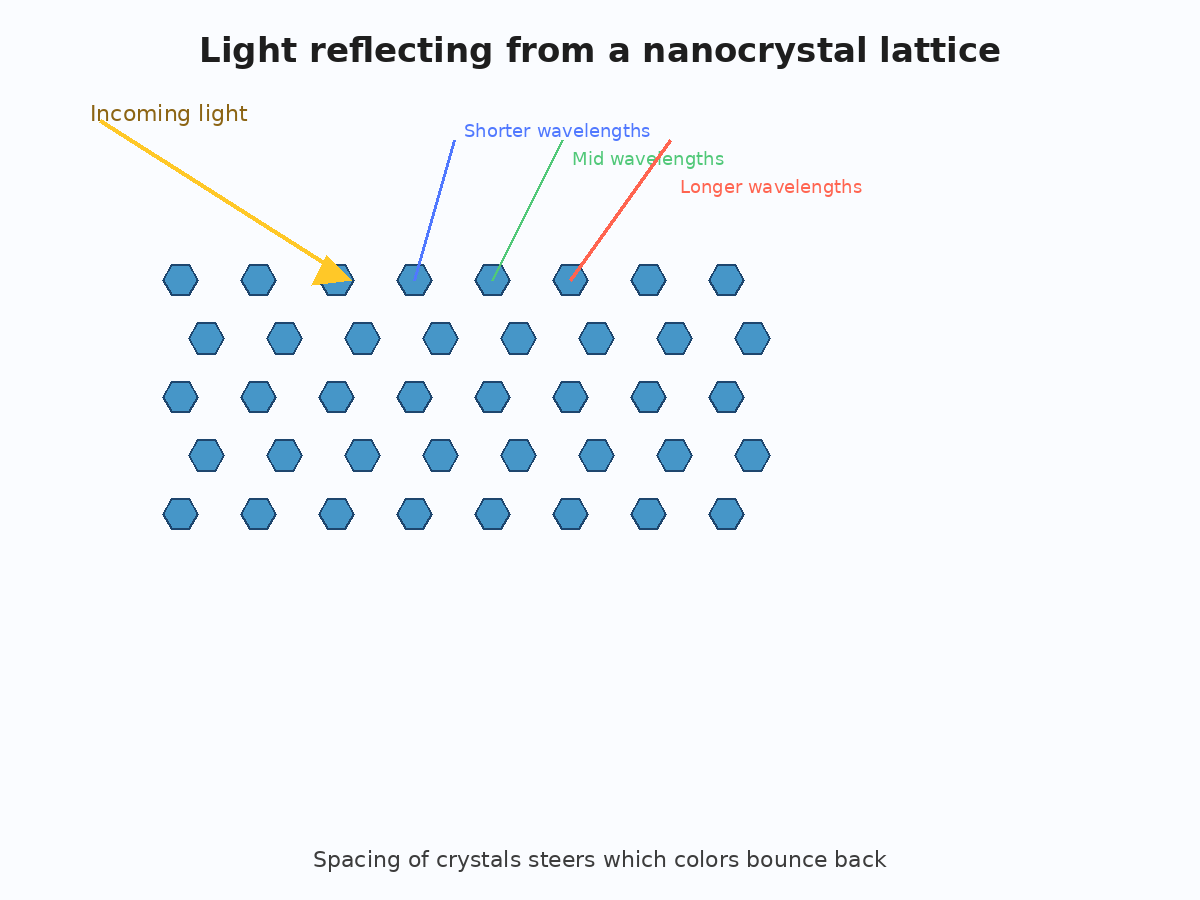
Iridophores hold platelets of guanine arranged as nanocrystals in a lattice. In the upper (superficial) iridophore layer of panther chameleons, that lattice behaves like a tunable photonic crystal. Spacing is the dial. Compress the lattice and shorter wavelengths are favored in the reflection spectrum; expand it and the reflection peak slides toward longer wavelengths. Calm animals often sit nearer the “blue-leaning” end of that continuum; aroused animals can shift toward yellow, orange, or red as the lattice opens.
This is not metaphor. Microscopy and optical modeling in the 2015 work connected lattice geometry to measured reflectance. The visible drama of a display is, in large part, physics of periodic structures interacting with sunlight.
A useful analogy—used carefully—is a tunable mirror stack. Change the distance between repeating layers and you change which colors bounce back most strongly. Chameleon iridophores are biological, wet, and living, so the analogy is incomplete, but it captures why spacing is the hero variable. Once spacing moves, the reflectance spectrum moves with it, and human (and lizard) eyes register a new hue even if the pigment inventory barely changed.
How pigment layers add yellow, red, and dark tones
Beneath or alongside the crystal story sit chromatophores with yellow and red pigments. Those pigments act like filters and tints: they carve the spectrum that finally escapes the skin. Melanophores contribute melanin. Dispersed melanin darkens the animal, muting brilliancy; retracted influence of the dark layer can let structural colors punch through.
So if nanocrystals set a shifting “base note,” pigments harmonize it. A structural blue filtered through yellow pigment can read as green. Expanded lattices plus red pigment and reduced darkening can produce the fiery faces of contested males. Color from light and color from pigment are partners, not rivals.
That partnership also explains why two animals with similar lattice states can still look different if their pigment loads or melanin dispersal differ—age, sex, health, and recent behavior all leave marks on the optical stack. Scientific descriptions therefore talk about spectra and layers, not a single “chameleon color setting.”
A note on species differences
Panther chameleons (Furcifer pardalis) dominate the modern structural-color narrative because their skin was examined with the tools needed to link lattice spacing to reflectance. Other chameleons change color too, but not always with the same speed, palette, or social choreography. Some emphasize browns and olive shifts; some rely more on darkening; sex and age reshape what is possible. Extrapolating every cartoon claim from one Malagasy showman to the whole family invites error.
When you read “chameleons change color,” ask which species and which kind of change—display flash, slow thermal shift, or subtle crypsis—is meant.
That habit also protects against over-reading pet-trade or viral videos. A single clip of a panther chameleon male in full display is spectacular and scientifically informative about that context, yet it is a thin sample of the family’s diversity. Comparative caution is part of accurate science writing, not a footnote.
Concept diagram of light bouncing from a crystal lattice
Quick facts checklist
Rapid hue shifts in well-studied panther chameleons lean on tunable guanine nanocrystal lattices in superficial iridophores, not paint alone.
Pigment chromatophores still supply yellow, red, and melanin-based darkening.
A deeper iridophore layer reflects near-infrared and is discussed in thermal contexts.
Common triggers: social display, arousal/mood-linked physiology, and temperature.
Camouflage can occur but does not fully explain high-contrast social colors.
Not every species matches panther chameleon optics or behavior.
Exact molecular control of lattice spacing is still incompletely known.
“Choosing” a color is a metaphor; physiological pathways drive the change.
Fast social flashes and slower thermal shifts are related but not identical processes.
Recap
How chameleons change color is best framed as structural color under biological control, supported by pigment layers. Light meets a living photonic lattice; spacing shifts rewrite the reflected spectrum; pigments and melanin finish the look. Signals from social life, internal state, and temperature decide when the lattice moves. Camouflage remains part of the broader ecology of appearance, yet it is not the master key to every flash.
If you remember only three ideas, make them these: (1) nanocrystal spacing is a major dial for rapid hue; (2) pigments and melanin still edit the final image; (3) flashy change is usually about signaling and body state more than stealth—with species differences and open questions about cellular control kept in view. Hold the cartoon lightly, keep the optics, and remember that one famous species does not speak for all.